
Sound, Frequency, and Wellbeing: Inside the Growing Conversation Around the Relief Disc
Walk into a wellbeing shop today and you'll notice something that wasn't there a decade ago. Alongside the candles and the soft blankets, there's a growing shelf devoted to sound. Singing bowls, tuning forks, gentle soundscapes, and newer objects designed around the idea of frequency. People are paying attention to the role sound plays in how a space feels, and the conversation is getting louder.
It's worth stepping back to ask why now, and why sound in particular. The short answer is that a quiet instinct most of us have always carried, that sound changes how a room feels, has met a moment where a lot of people are actively hunting for calm. The result is a conversation that's part ancient practice, part modern science, and part curiosity about objects we can keep within arm's reach. Here's a tour of it, and an honest look at where something like the Relief Disc sits inside the picture.
An Old Idea, Newly Popular
Humans have always reached for sound as a way to shift the mood. Lullabies to settle a child. Bells and chimes in places of quiet. The rhythmic drumming and chanting found across cultures and centuries. The instinct that sound can change how we feel is about as old as humanity itself.
What's new isn't the idea but the scale of the attention. The numbers behind the broader wellbeing world help explain the energy. The global wellness economy reached a record $6.8 trillion in 2024 and was growing at roughly 8% a year, according to the Global Wellness Institute. Sound is a small but fast-moving corner of that: the global sound therapy market was valued at around $2.5 billion in 2024, with most analysts forecasting steady growth through the next decade. Behind those figures sits a simple cultural shift. As more people look for simple, non-screen ways to create calm at home, the ancient relationship between sound and atmosphere has found a fresh, large audience.
 The wellbeing shelf has quietly made room for things you hear and feel, not just see.
Why Frequency Captures the Imagination
Part of the appeal is that frequency feels both scientific and a little mysterious. We know, from plain physics, that all sound is vibration, that every tone sits at a particular speed of oscillation measured in hertz, and that objects and spaces respond to the frequencies that pass through them. A low rumble moves slowly; a bright chime moves fast. None of that is in dispute. It's the textbook physics of waves.
That grounding in real, observable phenomena gives the conversation a foothold in something tangible. The way a room's acoustics shape how it feels. The way a low hum can settle a space. The way a particular note can set a wine glass humming across a table. People are naturally curious about the unseen forces that shape a room's atmosphere, and frequency offers a window into one of them. If you want to go deeper on that physics, the science of resonance is a fascinating rabbit hole.
It's worth being clear-eyed about where the solid ground ends, though. There's a difference between two kinds of claim that often get blurred together:
| Claim | Where it stands |
|---|---|
| Sound is vibration, and rooms and objects respond to frequency | Settled physics |
| Steady, gentle sound tends to help people feel calmer | Well supported by how our hearing and nervous system work |
| Specific "healing frequencies" cure specific conditions | Not established; treat with healthy skepticism |
The first two columns are where the interesting, honest conversation lives. The third is where marketing sometimes gets ahead of the evidence. Keeping those apart is the single most useful habit you can bring to this whole subject.
Nota. If anything sold around sound makes a firm medical promise, that's a signal to slow down rather than reach for your wallet. The most trustworthy voices in this space tend to talk about atmosphere, ritual, and how things feel, not cures.
What the Calmer Side of the Science Actually Says
Set aside the bigger claims and you're left with something useful, because the reasons gentle sound soothes us are not mysterious at all. Our hearing never fully switches off. Long before we could see in the dark, it was our early-warning system, quietly scanning for anything that might matter. In a steady, predictable sound environment, that monitoring relaxes. There's nothing sudden to brace against, so the body reads the room as safe.
This is why a soft, constant sound often feels calmer than total silence, in which every small creak stands out. A gentle background wash also smooths over the jagged edges of a space, blending the distant car or the sudden bump into something even and unalarming. If this idea interests you, the wellbeing science of why soft sounds help us settle walks through it in more detail. None of it requires special equipment or belief. It's just how listening creatures are wired.
What the Relief Disc Adds to the Mix
This is the context the Relief Disc steps into. It belongs to a wave of objects designed not to be watched or scrolled, but simply to exist in a space and contribute to its character. Rather than another screen demanding your focus, it's a physical thing you place in a room, part of the growing interest in shaping how a space feels through something other than visuals.
The conversation around it tends to focus on atmosphere and ritual, the way a dedicated object can mark a moment, anchor a calm corner, or become part of an evening wind-down. Like a favourite candle or a particular blanket, its value lies partly in what it represents: a deliberate cue that it's time to slow down. There's a real, well-documented reason a held or placed object can feel steadying, rooted in how weight and texture ground us. The object gives scattered attention somewhere concrete to land.
A wellbeing object earns its keep not by promising to fix you, but by quietly reminding you to pause. That cue, repeated, is where most of the value lives.
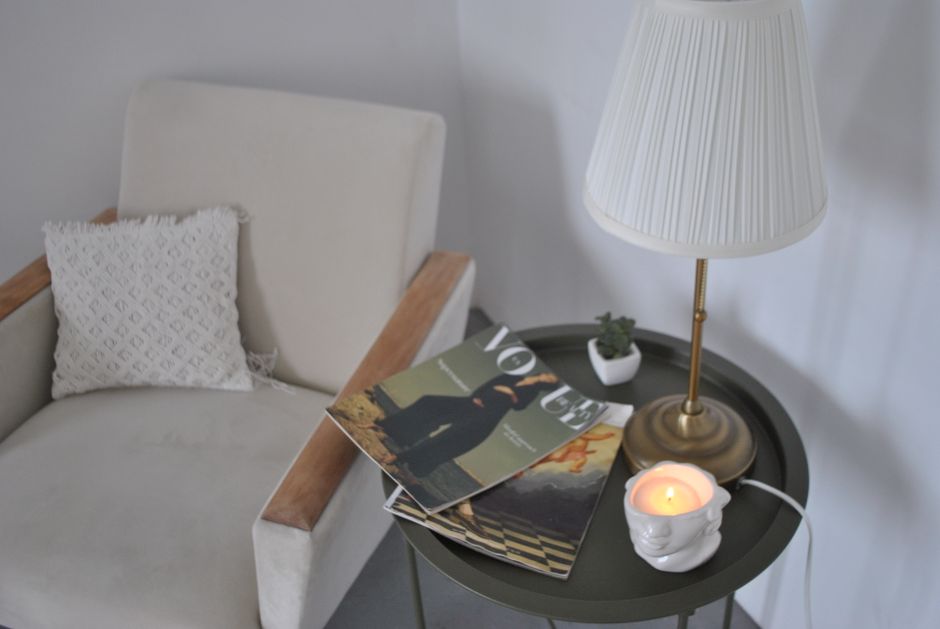 The point is less the object itself and more the moment it marks.
Trying It For Yourself, Sensibly
The healthiest way into all of this is to treat it as an experiment rather than a belief. You're not signing up to a worldview; you're noticing what helps you settle and keeping that. A loose way to do it:
- Pick one cue, not five. Choose a single change, a softer soundscape in the evening, say, and live with it for a week before adding anything else.
- Notice the before and after. Pay attention to how a room feels when you walk in and how your shoulders sit after ten minutes in it. The body is a more honest reviewer than the marketing.
- Pair cues that agree with each other. Soft light, a warm drink, a lowered volume, and a familiar object reached for at the same time each evening reinforce one another. Building a calmer evening routine around them helps the whole thing stick.
- Keep what works, drop what doesn't. If a particular sound, object, or ritual quietly earns its place over a few weeks, keep it. If it doesn't, let it go without ceremony.
A quick gut-check before you bring anything new home:
- Does it describe how it makes a space feel, rather than promising to cure something?
- Would I still want it as part of a ritual even if it did nothing measurable?
- Does it fit a corner I actually use, or just a corner I imagine using?
- Am I buying calm, or buying the idea of calm to skip past doing the slower work?
That last question is the kindest one to ask. No object substitutes for the simple practices, slowing down, putting the phone away, giving yourself a real pause, that actually move the needle. At their best, objects support those habits. They don't replace them.
A Few Honest Questions People Ask
Do I need any of these objects to feel calmer at home? No. The fundamentals, soft light, lowered noise, a real pause, cost nothing. Objects can make those easier to remember and more pleasant to repeat, which is a genuine benefit, but they're an accelerant, not the engine.
Is there real science here, or is it all atmosphere? Both, sitting side by side. The physics of sound and the basics of how we respond to steady, gentle soundscapes are well established. The grander, condition-specific claims are not. Hold the first firmly and the second loosely.
How do I avoid being oversold? Watch the language. "Helps a room feel calmer" is honest. "Heals" or "cures" is a flag. And notice your own motive: an object bought as part of a ritual you'll actually keep is money well spent; one bought as a shortcut past the slower work usually ends up in a drawer.
 The cues that help most are usually the simple, repeatable ones.
Where the Conversation Is Heading
The interest in sound and frequency shows no sign of fading, and it fits a broader cultural mood, the turn toward calmer homes, away from screens, toward objects and rituals that help us feel grounded. As that mood deepens, expect the conversation to keep growing, with new objects and ideas joining it along the way, and with the same healthy tension between genuine curiosity and overblown promises.
The Relief Disc is one thread in that larger story, a story about people seeking out simple, physical ways to shape the spaces they live in. Whether it's sound, light, texture, or ritual, the underlying wish is the same: to make our surroundings feel a little more like a refuge. Approached with open ears, a bit of skepticism where it's warranted, and a willingness to let your own experience be the judge, that's a conversation worth being part of.
Sources: Global Wellness Institute, 2024 Global Wellness Economy Monitor; sound therapy market sizing via Straits Research.