
Building a Calming Evening Routine: A Step-by-Step Guide to Winding Down
The hours between dinner and bed have a way of disappearing. One minute you're tidying the kitchen, the next it's late and you're somehow more wound up than you were an hour ago. The evening slips into a strange limbo, too tired to be productive, too keyed up to truly relax, and you go to bed feeling vaguely cheated of the rest you were sure was coming.
Most of us have never been taught how to end a day. We know how to start one, more or less, but the closing hours are left to drift. So they fill with whatever is loudest: the second screen, the lingering work thought, the scroll that was meant to last five minutes. None of it is restful, exactly, but none of it feels like a decision either. It just happens to us.
A calming evening routine is the opposite of that. It's not about cramming more self-care tasks into an already full night, and it's certainly not about turning your living room into a wellness retreat. It's about giving the day a deliberate, soft ending instead of letting it trail off into the dark. What follows is a step-by-step way to build one that fits the life you already have, not the tidy one you keep meaning to start.
A quick word before the steps. You won't do all of this on night one, and you shouldn't try to. A routine assembled all at once tends to collapse all at once. The version that lasts is the one you grow slowly, a piece at a time, until the whole thing runs without you thinking about it.
Step One: Pick a Closing Time
Decide on a rough moment when the working part of your day ends. Not when you go to bed, but when you stop reaching for your to-do list. This might be eight o'clock, or nine, or simply whenever the dishes are done.
The point is to draw a line. Before it, you're still in motion. After it, the evening belongs to rest. You don't have to enforce this like a curfew, and you shouldn't, because nothing breeds rebellion like a rule that feels rigid. Treat it instead as a gentle handover, the moment you hand the day back to yourself.
What makes this step quietly powerful is that it gives everything after it a reason to exist. Without a closing time, "relaxing" is just the absence of work, and absence is hard to feel. With one, the evening becomes a thing with a shape and a beginning. Even on the nights the line slips later than you'd hoped, the act of having one keeps you from drifting endlessly. A soft boundary you cross most nights does far more than a strict one you resent and abandon by Thursday.
Step Two: Lower the Lighting
Bright light tells your body it's still daytime. Light is one of the strongest cues your internal clock uses to tell day from night, and a ceiling full of brightness in the evening can keep your natural production of melatonin, the hormone that helps you feel drowsy, running later than you'd like. This is why a room that felt perfectly normal at noon can feel jarring at ten.
So as your closing time arrives, start turning off the big overhead lights and switching to softer, warmer sources. A lamp in the corner. A candle if you like them. The string of small lights you forgot you owned. Think of the lighting you'd find in a quiet restaurant rather than a kitchen at midday. Whatever takes the room from "office" to "evening" is the right choice.
This single change does a surprising amount of work for how little it asks. The shift in light is a cue your body reads almost without thinking, and it sets the tone for everything that follows. If you do nothing else from this entire guide, do this. Many people find it's the change that makes the rest feel natural rather than forced, and it costs nothing but the flick of a switch.
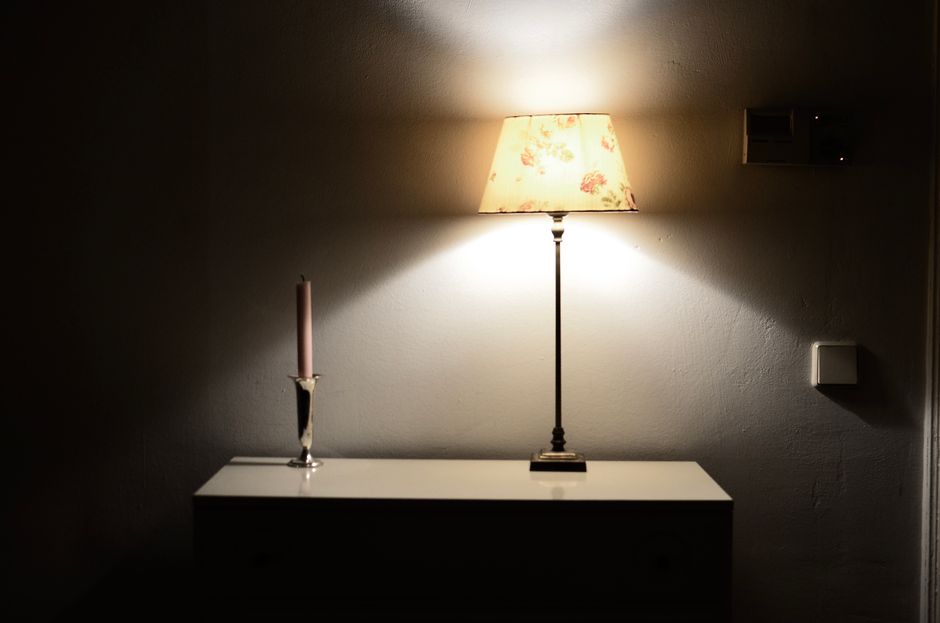 Trading overhead brightness for one warm source is the cue your body reads first.
Step Three: Tidy One Small Thing
You don't need to clean the whole house, and you certainly shouldn't start a deep-clean at nine in the evening. Choose one small reset: clearing the coffee table, wiping the counter, folding the throw blanket back over the arm of the sofa. A little visible order helps the mind settle, because a cluttered space keeps offering the eye unfinished business, and unfinished business is the enemy of rest.
There's something quietly satisfying about ending the day with one corner of your world put back in place. It signals completion, and completion is restful. The trick is to keep it genuinely small. The goal isn't a spotless home; it's a single visible patch of calm you can rest your eyes on.
Note. If tidying tends to spiral for you, one task easily becoming ten, set a hard limit. One surface, or two minutes, then you stop whether it's "done" or not. The point is the sense of closure, not the cleaning.
Step Four: Step Away From Screens
Screens are the loudest part of most evenings, even when they're silent. The endless scroll, the late email, the show that quietly becomes three shows. The light they throw is bright and close to your face, and the content is built to keep you engaged, which is the precise opposite of winding down. None of it is forbidden. But the closer you get to bed, the less it actually serves you.
Try setting your phone somewhere out of reach for the last stretch of the evening, ideally a different room, because a phone within arm's reach is a phone you'll check. Read a few pages of a paper book instead. Listen to something slow. Or simply sit without anything demanding your attention. The quiet feels uncomfortable for about ninety seconds, a real, almost itchy discomfort, and then it turns into something close to relief.
If going cold-turkey on screens feels unrealistic, and for many people it is, soften the edges instead of cutting them. Dim the screen and warm its colour as far as it'll go. Swap the stimulating feed for something gentle and finite, a film with an ending rather than an algorithm without one. Winding down from screens is less about banishment than about choosing the calmer version of the same hour. If the restless pull of the evening feels familiar, it's worth understanding what the modern wind-down problem is really about, because naming the pattern makes it easier to loosen.
Step Five: Move Gently
A short, slow stretch can release the tension that builds up across a long day without waking you back up. Reach your arms overhead, roll your shoulders, fold forward and let your head hang and your arms dangle. Nothing strenuous, nothing that counts as a workout. Just enough to remind your body it's allowed to loosen its grip.
Pay attention to the places we quietly clench all day. The shoulders, which creep up toward the ears without our noticing. The jaw, which holds a surprising amount of low-grade effort. Let them drop, once, on purpose. That small, deliberate release is a signal your body understands instantly, and a few of these tiny sensory cues strung together can do more than a long stretching session you never quite get around to.
If stretching isn't your thing, a slow walk around the block works just as well, and the cool evening air is a bonus. The aim is unhurried movement, the kind that drains the leftover restlessness from your limbs rather than the kind that revs you up. Slow is the whole point; the pace is the message.
Step Six: Find a Small Comfort
This is the part of the routine you should genuinely look forward to, and if you don't, you've picked the wrong comfort. A cup of caffeine-free tea, hands wrapped around the warm mug. A warm shower, where the cool-down afterward gently mirrors the drop in body temperature that comes with sleep. A familiar scent. A soft object you reach for only in the evening, perhaps a Relief Disc kept by your chair as a small marker that the day is winding down. The specific thing matters far less than the feeling it gives you, and the consistency with which you return to it.
Comfort is the part that makes a routine stick, and most routines fail precisely because they skip it. If the evening feels like a chore, a checklist of virtuous tasks, you'll quietly abandon it within a week. If it feels like a reward you've earned, you'll protect it. The aim isn't to be optimized or disciplined; it's to build something good enough that you actually want to come back to it tomorrow. A warm drink earns its place here for exactly this reason, and there's a real wellbeing science behind why a simple ritual soothes us that goes well beyond the warmth itself.
Step Seven: Set Down the Day
Before you head to bed, give your thoughts somewhere to land. The mind, left to itself, will keep circling unfinished business right up until the moment you're trying to sleep, which is why so many people lie down exhausted and find themselves wide awake.
A few simple options, none of which take long:
- Write three lines about the day. Not a journal, not an account of yourself, just three honest lines. What happened, what you noticed, what you're glad is over.
- Park tomorrow's first task on paper. Jotting down the single thing you'll do first thing in the morning lets your brain stop rehearsing it. The page holds it so you don't have to.
- Let it replay once, then let it go. If writing feels like effort, simply sit quietly and let the day run through your mind a single time. Then deliberately close it, the way you'd shut a book.
Any one of these keeps the day from following you under the covers. When your mind knows the loose ends are accounted for, somewhere it trusts, it stops circling back to them. This step costs two or three minutes and saves you the ones you'd otherwise spend staring at the ceiling.
When You Only Have Five Minutes
Some nights there's no room for seven steps. You get in late, you're flattened, the whole sequence feels like one more thing being asked of you. On those nights, don't reach for the full routine. Reach for a tiny version of it.
Pick one cue and one comfort. Lower the lights and hold a warm mug. Or step away from the screen and take three slow breaths with a longer exhale than inhale. The point of the short version isn't to do everything; it's to keep the thread unbroken, so the routine still feels like yours even on the nights it shrinks to almost nothing. A five-minute wind-down done on a hard night does more for the habit than a perfect one skipped entirely.
A routine survives not because you never miss it, but because the version you keep is small enough to manage on your worst evening.
Putting It Together
You don't need all seven steps from night one, and trying to install the whole thing at once is the surest way to quit. Start with the lighting, or the screens, or the small comfort, whichever feels easiest and most appealing. Let it become natural, genuinely automatic, before you add the next. A piece a week is plenty.
Over a couple of weeks, these pieces stop feeling like steps and start feeling like a shape, the familiar downward curve of an evening that knows it's heading toward rest. If you'd like a parallel version for the other end of the day, the same gentle logic applies to building a calmer morning routine, and the two routines tend to reinforce each other once they're both in place.
And the night you notice you've drifted through the whole sequence without thinking about it, dimming the lights, setting down the phone, reaching for the thing that means the day is done, you'll know the routine has quietly stopped being something you do and become simply how your evenings end.